
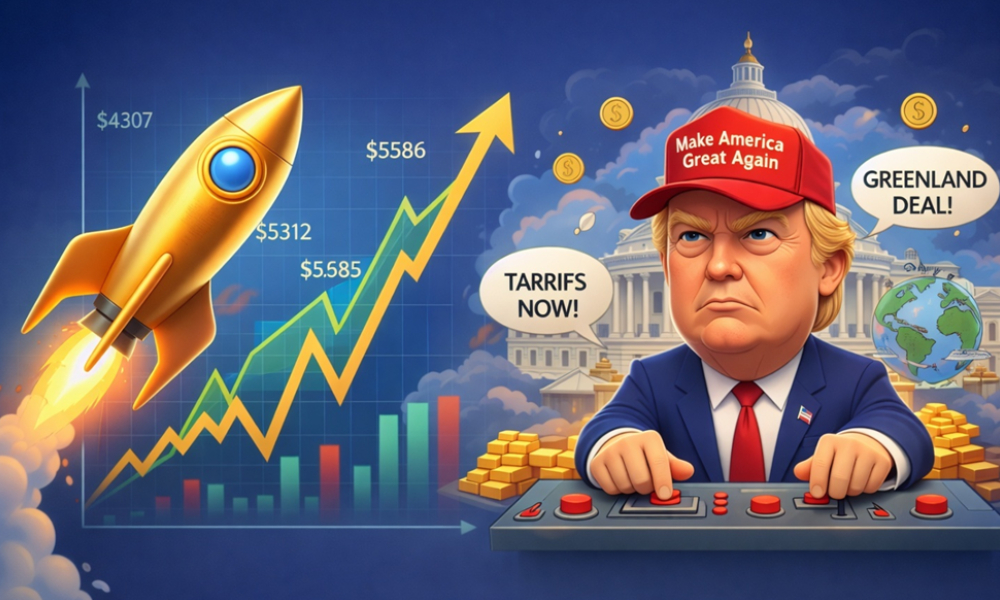
As geopolitical flashpoints multiplied and policy shocks rippled out of Washington under Donald Trump, investors ran for cover and straight into bullion. Bullion analyst Sanjiv Arole sums it up.
The year 2026 began in an atmosphere of escalating political risk. The US, under President Donald Trump, took an aggressive foreign policy stance that unsettled markets. Washington intervened in Venezuela’s leadership crisis, pressed Denmark over Greenland, threatened fresh tariffs on European allies, and positioned the US armada near Iran and in the South China Sea. Tensions rose alongside pressure on the Federal Reserve, with public attacks on Chair Jerome Powell to push for lower rates.
For investors, the message was simple. Uncertainty was back. Safe havens were in demand.
Precious metals reacted immediately. Gold opened the year at $4,307.95 per ounce and surged more than 23% within weeks, touching $5,312 on 28 January and repeatedly setting fresh highs. Silver outpaced even that rally, climbing 63% to $117.69. Platinum joined the move, rising 37% to $2,923.70. Capital flowed rapidly into hard assets as traders hedged against conflict, inflation, debt concerns and currency risks.
Volatility soon became the norm. On 29 January alone, gold swung almost $500 in a single session. It spiked to $5,585, dropped sharply, rallied again to $5,596, then slid back near $5,100. Silver moved to new highs above $119 and $121 but with comparatively tighter swings. The message from markets was clear. Momentum was strong, but nerves were frayed.
Broader macro pressures reinforced the rally. Reports suggested the IMF was bracing for stress in the US dollar. The Fed kept rates unchanged at its late January meeting. Trade tensions widened, with Canada pressed to rethink ties with China. Persistent US debt, inflation worries and recession fears added to the risk premium already embedded in prices.
Against this backdrop, forecasting metals looked almost futile. The annual survey by London Bullion Market Association (LBMA) highlighted how far analysts had missed the mark the previous year.
In gold, the winning 2025 forecast was $2,925 per ounce. The actual average price came in at $3,431.54, more than 17% higher. Gold had started 2025 near $2,644 and ended above $4,300, a rise of over 62% with multiple record highs along the way.
Silver’s story was even more dramatic. Prices jumped nearly 144% through 2025, from $29.40 to $71.99, after touching $83.93 at peak levels. Yet most predictions clustered far below reality. Even the best estimate undershot the move. Long-held ceilings, including the $50 level that had stood for decades, were swept aside.
Platinum and palladium followed suit. Platinum reached $2,514 during the year, far above most expectations, while palladium climbed more than 100%. Forecasts across the board proved consistently conservative. Reputations built on careful modelling were shaken by the speed of the moves.
Despite the misfires, analysts returned with fresh numbers for 2026. Gold projections ranged widely, from $3,500 to $7,150, with an average of $4,741.97 per ounce. The key drivers cited were geopolitical risk at 21%, Central Bank buying at 17%, and US monetary policy at 10%. Notably, average expectations for 2026 were more than 73% higher than those made a year earlier, reflecting how quickly sentiment had shifted.
Silver forecasts turned sharply bullish. Analysts pencilled in an average price near $79.57, almost double the 2025 average, with highs as steep as $165. Structural supply deficits, limited mine expansion and rising demand from electronics, electrification, AI technology and renewable energy underpinned the optimism. At the same time, its link to gold and safe haven flows strengthened its appeal. Yet at elevated levels, demand destruction in jewellery and silverware remains a real risk.
Platinum estimates centred around $2,222.14, up more than 74% from the prior year’s average, while palladium forecasts suggested gains above 50%. The consensus view pointed to tight supply and improving industrial usage, though traders remained wary of sharp reversals.
Then came a sharp reality check. On 31st January, a stronger dollar and expectations of a more hawkish Fed leadership triggered a virtual bloodbath in the precious metals market. Gold dropped from $5,452 to $4,691 in a single day before stabilising near $4,891. Silver fell harder, sliding from $118.58 to the low $70s before rebounding to the mid $80s. Even after the fall, both metals stayed well above their levels at the start of the year.
The first month of 2026 therefore closed with a clear pattern. Big gains, sudden drops, and constant repositioning.
Looking ahead, buyers are likely to treat dips as opportunities, while jewellers hope for softer prices to revive retail demand. Investors may pause, allowing a period of sideways trade. But the underlying driver remains political risk.
As long as Donald Trump’s policy shocks, tariff threats and military posturing dominate headlines, gold’s safe haven appeal will persist. In this climate, calm is fragile and forecasts carry less weight than events. For precious metals, turbulence has become the base case rather than the exception. As long as there is Trump anything is possible!
Disclaimer
The views expressed in the article are those of the author and do not necessarily reflect the views of the GJEPC.