
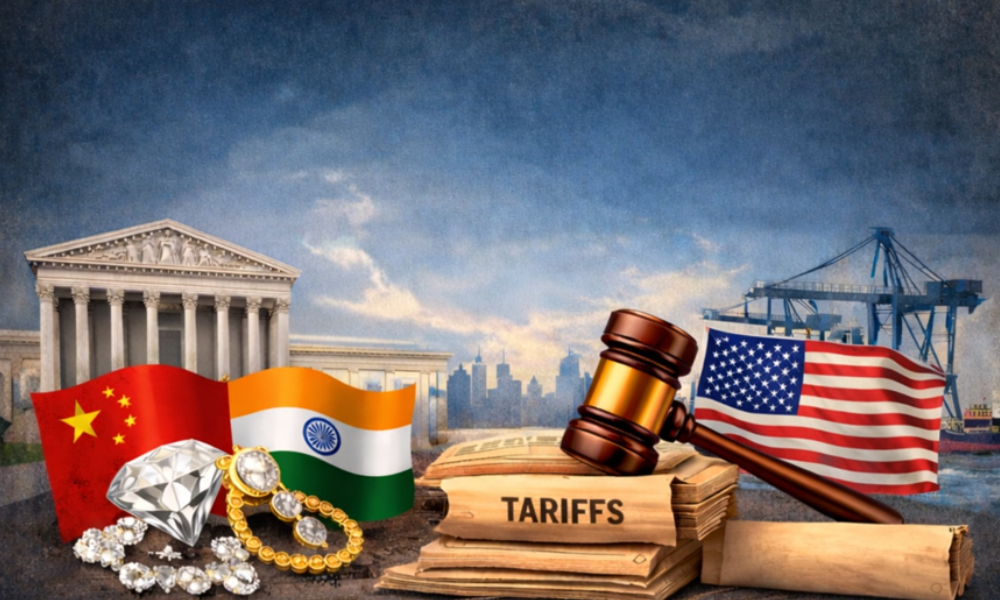
The US Supreme Court’s tariff ruling signals a rebuilt framework rather than simpler duties. For India and China, both key suppliers to the US jewellery market, the real impact will depend on how the new tariff stack takes shape and how buyers rebalance sourcing.
The US Supreme Court’s recent decision limiting the use of the International Emergency Economic Powers Act (IEEPA) for broad tariff action has triggered a fresh round of assumptions in the gem and jewellery trade. The most common misread is that “tariffs are easing”. A more accurate description is that the United States is entering a period of tariff-structure reconstruction: one legal pathway has been constrained, while alternative tools remain available and may be deployed quickly.
For the US jewellery market, where India and China are both major suppliers and where Hong Kong SAR functions as both a global trading hub and a meaningful manufacturing/high-value processing centre, the commercial question is not a single headline rate. It is how the tariff stack is rebuilt, what layers remain origin-specific, and how US buyers will rebalance sourcing across cost, execution reliability, and compliance risk.
1) Understanding the scope and limits of the ruling
In essence, the Supreme Court did not declare tariffs unlawful in general. It ruled that IEEPA is not a tariff statute—it does not provide the clear Congressional authorisation required for sweeping, across-the-board duties. This matters because tariff measures explicitly grounded in IEEPA now face a serious legal barrier and may be paused, revised, or reissued under different authorities.
Equally important, the ruling does not remove the broader US policy toolkit. Measures based on other statutes—most notably Section 301 trade enforcement actions targeting certain “products of China”—are not struck down by this decision. The likely policy pattern, therefore, is continuity through substitution, not a clean reset.
2) The jewellery trade with “tariff stacks”
For diamonds, coloured stones and jewellery articles, US landed cost typically reflects multiple layers:
- the HTS base duty(Harmonized Tariff Schedule “General” rate, often treated as MFN/Normal Trade Relations), and
- one or more policy layers implemented via HTS Chapter 99codes (temporary surcharges, enforcement duties, sector measures), plus
- any origin-specific overlays (for example, Section 301on certain China-origin lines).
This structure is central to India-China analysis. A change in one layer (such as an IEEPA-based surcharge) can narrow or widen the effective tariff hurdle, but the net outcome depends on what remains in the stack and what replaces it.
3) India and China should be analysed together
Although the ruling is a US domestic legal event, its commercial impact is transmitted through US buyers’ sourcing decisions and risk management.
India’s position in the global jewellery ecosystem is well known: a leading natural diamond processing centre, a significant lab-grown diamond growing and processing base, and an important gold jewellery manufacturing origin. Chinese mainland remains a major jewellery manufacturing centre and a significant participant in the lab-grown diamond value chain. Hong Kong SAR should be viewed through a dual lens: it is a global trading and distribution hub supporting financing, consolidation, logistics, and execution, and it also hosts meaningful manufacturing and higher-value processing capacity in certain segments.
When tariff layers shift, US buyers rarely “switch” suppliers in a binary way. More commonly, they recalibrate order allocation across India, China (including Hong Kong-linked) trade paths, and other alternatives by re-running landed-cost models and re-weighting execution variables.
4) The policy pivot and the next 150 days
Following the ruling, public reporting has pointed to a temporary worldwide import surcharge framed around a defined 150-day window, a design widely associated with the Trade Act of 1974, Section 122. Exemptions have been discussed at a category level (for example, certain critical minerals, bullion/monetary metals, energy products, selected pharma inputs, certain electronics, and some automotive/aerospace lines). Separately, Trump’s public comments have signalled an intention to adjust the level of a “worldwide tariff” and to issue “new legally permissible tariffs” in the coming months.
For the jewellery trade, the operational takeaway is clear: even if IEEPA-based layers are constrained, tariffs may persist through alternative legal routes. The 150-day structure is commercially significant because it creates a defined horizon after which the surcharge may lapse, be extended, or be replaced by more targeted tools. This is why the current phase should be understood as reconstruction, not resolution.
5) India vs China: competitiveness under a rebuilt stack is scenario-dependent
It would be premature to assume that any single origin “wins” automatically from the IEEPA constraint. Outcomes will depend on the interaction of at least three moving parts: (i) which IEEPA-based layers are removed in execution, (ii) which non-IEEPA layers remain, and (iii) what replacement tools are adopted.
For India, the net effect depends in part on whether India-related reciprocal rates were implemented through IEEPA-linked constructs, and more importantly on what replacement architecture the administration adopts. A broad temporary surcharge applied across most origins would compress relative differences, while more targeted measures could preserve or reintroduce origin-specific gaps. India’s competitiveness may improve in some scenarios, but the magnitude and durability of that improvement should be treated as contingent rather than automatic.
For China, the practical impact similarly depends on which China-related IEEPA surcharges are removed in execution and which non-IEEPA layers remain. If China-specific IEEPA measures (including fentanyl-related surcharges) are discontinued in practice, China’s landed-cost position would improve relative to the prior regime. However, residual layers, for Chinese mainland only, such as Section 301 on many tariff lines, and the possibility of new legally-structured replacement measures, could continue to shape the net gap versus other origins. In a compressed-differential environment, non-tariff factors—manufacturing workmanship and technology, product consistency, lead-time reliability, capacity flexibility, and documentation credibility—are likely to play a larger role in sourcing decisions.
6) Order rebalancing and US buyer behaviour
If IEEPA-based China-specific surcharges are removed in practice, US buyers will re-run their landed-cost models for China versus alternative sources. The immediate effect would be a narrower tariff hurdle for certain China-origin lines, jewellery originating from Hong Kong SAR may even face a tariff threshold comparable to that of India-origin products; the commercial effect, however, will likely express itself as a rebalancing rather than a binary shift. Buyers typically weigh tariff-adjusted cost alongside execution variables: workmanship/technology, delivery reliability, inventory cycle considerations, and compliance risk.
In this rebalancing, India’s scale and ecosystem depth remain structural strengths—particularly for standardised, high-turn SKUs and scalable programmes—while China’s integrated manufacturing base and process/technology advantages can become more relevant if the tariff gap narrows. Hong Kong SAR’s role can expand in a volatile regime because it supports trade execution, financing, consolidation, and—where applicable—manufacturing and higher-value processing. Between China and India, the practical differentiator in the coming months may be who can quote cleanly, ship predictably, and evidence compliance convincingly.
7) What to watch next: implementation detail over headlines
Over the next several months, outcomes will be shaped less by rhetoric and more by execution detail: which legal authority is used for replacement tariffs; whether gems and jewellery lines are explicitly exempted in annexes and Chapter 99 instructions; how effective dates and “in-transit” rules are applied; and whether refund/protest timelines become commercially relevant if duties are later challenged. The end of any 150-day period is also a natural decision point: expiry, extension, or replacement each implies a different tariff stack.
Closing thoughts
The US Supreme Court ruling closes a specific legal pathway of IEEPA as a foundation for broad tariffs, but it does not end tariff policy. For the gem and jewellery trade, the near-term reality is a reconstructed tariff stack, not a guaranteed reduction. Relative competitiveness between India and China will be determined by how replacement tools interact with residual non-IEEPA layers and by how US buyers weight execution-driven criteria such as quality, technology, delivery, and compliance credibility. The most prudent stance for industry is continuous monitoring and scenario planning rather than assuming a single linear “tariff down” trajectory.
Disclaimer:
The views expressed in this article are those of the author and do not necessarily reflect the views of the GJEPC.
Liang Weizhang, CEO of HubWis Jewellery Strategic Creations (Guangzhou) Co., Ltd., is a senior analyst and strategic researcher in the jewellery industry. He is the founding President of the Guangzhou Diamond Exchange and Vice Chairman of the Guangdong Gold Association. With nearly 30 years of experience in the diamond, gold, and jewellery sectors in China and internationally, Liang offers deep industry insight and a strong professional network. His company supports jewellery businesses with strategic consulting, industry advice, and access to global markets.