
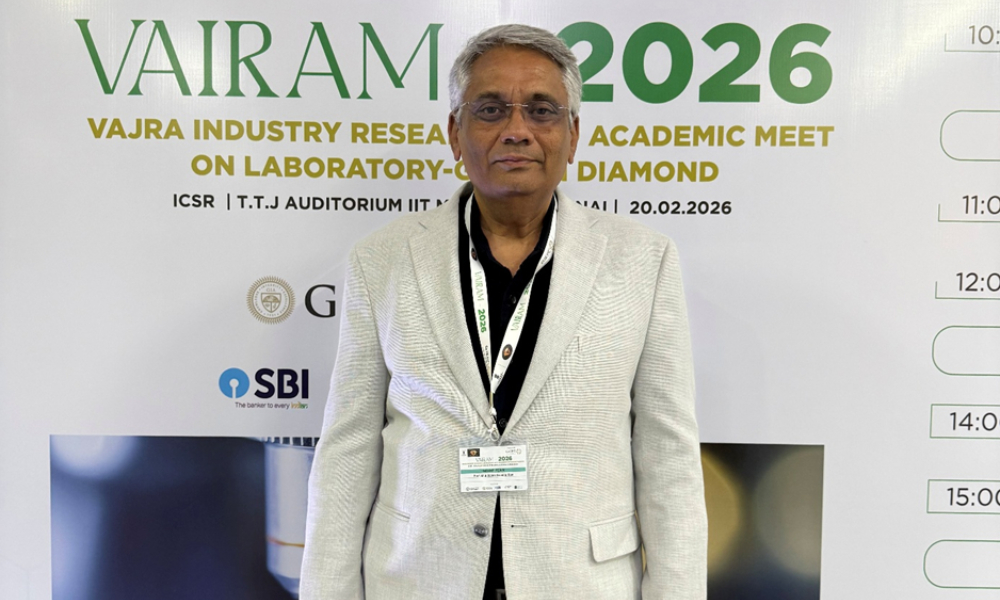
In conversation during the Vajra Industry Research & Academic Meet (VAIRAM) 2026, Prof. M.S. Ramachandra Rao, Head of the India Centre for Lab Grown Diamond (InCent-LGD), IIT Madras, discusses the progress made over the past year, the push for indigenous technologies, and India’s opportunity to lead in deep-tech diamond applications.
VAIRAM 2026 is strongly focused on moving from research to commercialisation. What progress has InCent-LGD made over the past year?
Over the past year, we have made significant progress in several priority areas that were outlined earlier. One notable achievement is the development of diamond marking technology that enables identification without damaging the material quality. This is a first-of-its-kind approach and required substantial research effort.
If you compare what we projected last year with what has been achieved now, the progress has been quite substantial. We are moving steadily toward technologies that are closer to industry adoption.
You have consistently emphasised indigenous capability in CVD and HPHT systems. How close is India to reducing import dependence?
In CVD technology, we are almost there. I would say that within the next six to eight months, we should have our own indigenous CVD machine ready.
For HPHT, we have already developed a prototype. However, a commercial-scale system will take longer, possibly another year to a year and a half. That said, I am confident that India will reach that stage.
Which applications beyond gems are showing the most promise today?
For me, diamond is far beyond gemstones. There are numerous opportunities in electronics, quantum technologies, high-power devices and magnetometry. Diamond is a next-generation material for many of these applications.
The key challenge is achieving extremely high purity levels. Gem applications do not require the same level of purity as electronic applications, where material quality becomes critical. Once that barrier is addressed, the opportunities expand significantly.
Have you seen stronger engagement from manufacturers, start-ups or investors over the past year?
Yes, there is growing interest. Manufacturers are approaching us to understand when the technologies will mature enough for them to invest. I believe that by the end of this year, we will see some technologies transitioning into larger-scale deployment.
The ecosystem is gradually aligning, which is encouraging.
From a policy perspective, what interventions could accelerate India’s leadership in this sector?
Two priorities stand out. First, India should aim to become a global leader in electronic-grade and quantum-grade diamond production. This is where the highest value lies, and it moves us beyond gemstone manufacturing.
Second, we need indigenous certification systems. Currently, we rely heavily on foreign entities for certification. With our capabilities, we should develop standard operating procedures and certification frameworks within India, especially for lab-grown diamonds.
What breakthroughs do you foresee in the near future?
One major focus is developing quantum-grade diamonds with controlled nitrogen-vacancy (NV) centres. Once we achieve that level of control, we can start building devices based on these materials, particularly for magnetometry and nuclear magnetic resonance applications.
These areas have strong potential and could open new technology markets.
You have previously spoken about India missing the silicon opportunity. How can India ensure it does not miss the ‘diamond opportunity’?
The key is perseverance and sustained effort toward clearly defined goals. We must continue investing in research, infrastructure and talent without losing momentum.
From what I see today, we are on track. If we maintain this pace and alignment across academia, industry and policy, I am confident that India will not miss the diamond opportunity.
What would success look like for India in the next few years?
Success would mean India becoming not just a manufacturing hub, but also a technology leader in next-generation diamond applications. That includes indigenous machines, advanced materials, device development and certification capabilities — a complete ecosystem.