

Export in itself is a very wide concept and lot of preparations is required by an exporter before starting an export business.
Video on ‘Guide to Exports’ is created by the GJEPC to make the aspiring and existing entrepreneurs learnt about-
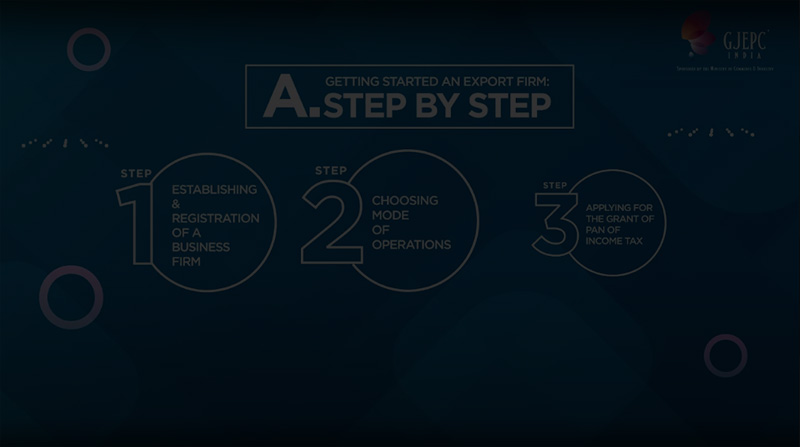
GJEPC - Export Guide
Choosing the nature of business entity as proprietorship, partnership, limited liability partnership, private company, limited company, Trust, Registered Society and HUF and get it registered as per the respective laws in the country.
A Firm should decide the mode of doing exports operations either as a merchant exporter, manufacturer exporter or merchant cum manufacturer exporter.
This is necessary obtain a Permanent Account Number (PAN) issued from Income Tax Department after applying at https://www.onlineservices.nsdl.com/
This is a requirement to open the current A/C in the name of the proposed business firm and to apply for the allotment of IEC No.
A current account with a Bank authorized to deal in Foreign Exchange should be opened. Authorised Dealer Code (AD code) – a 14 digit numerical code is issued by the bank which is to be registered with the Customs
In order to obtain Goods and Services Tax Identification Number (GSTIN No.) which is required for claiming the refund of taxes a firms needs to register with the Goods and Services Tax Department by applying at https://www.gst.gov.in/
An Importer -Exporter Code (IEC) is a key business identification number which mandatory for export from India or Import to India. No export or import shall be made by any person without obtaining an IEC unless specifically exempted. For services exports however, IEC shall be not be necessary except when the service provider is taking benefits under the Foreign Trade Policy.
Consequent upon introduction of GST, IEC being issued is the same as the PAN of the firm. However, the IEC will still be separately issued by DGFT based on an application. The nature of the firm obtaining an IEC may be any of the follows- Proprietorship, Partnership, LLP, Limited Company, Trust, HUF, Society.
Pre-Requisites for Applying for IEC
IEC may be applied on behalf of a firm which may be a Proprietorship, Partnership, LLP, Limited Company, Trust, HUF, Society. Firm must have a PAN, bank account in the name of the firm and a valid address before applying. Address may be physically verified by the DGFT on issuance of the IEC. Please keep your PAN, bank details and firm details ready before applying.
Para 2.05 of the Foreign Trade Policy (FTP) of 2015-20 lays down the procedure to be followed for obtaining an IEC, which is PAN based.
An application for IEC is filed online at https://dgft.gov.in/CP/ IEC Profile Management as per ANF 2A, online payment of application fee through net Banking or credit/debit card can be made along with requisite documents as mentioned in the application form.
After obtaining IEC , this is necessary to register an AD Code at every port from where goods are cleared by customs as the EDI system of the Ice Gate portal does not allow the generation of the shipping bill in the absence of a registered AD Code. In case of being eligible for the government benefits, an AD Code registration with the customs enables a firm to get the same directly credited into your current account.
It is necessary to obtain PAN based Business Identification Number (BIN) from the Customs prior to filing of shipping bill for clearance of export goods.
For availing authorization to import/ export or any other benefit or concession under FTP 2015-20, as also to avail the services/ guidance , the exporters are essentially required to obtain Registration cum membership certificate (RCMC) granted by the concerned Export Promotion Councils/ FIEO/Commodity Boards/ Authorities.
For Gems and Jewellery commodities falling under chapter 71, Gem and Jewellery Export Promotion Council (GJEPC) is the Export Promotion Council. For applying visit at www.gjepc.org
Indian Customs Electronic Gateway (ICEGATE) is the national portal of Indian Customs of Central Board of Indirect Taxes and Customs (CBIC) that provides e-filing services to the Trade, Cargo Carriers and other Trading Partners electronically.
IEC holders need to register their IEC on the portal for availing e-Sanchit facility. For the registration on Icegate portal Cass III Digital Signature is mandatory.
https://www.icegate.gov.in/eSANCHIT.html
https://www.icegate.gov.in/Download/v1.2_Advisory_Registration_APPROVED.pdf
All items are freely exportable except few items appearing in prohibited/ restricted list. After studying the trends of export of different products from India proper selection of the product(s) to be exported may be made.
An overseas market should be selected after research covering market size, competition, quality requirements, payment terms etc. Exporters can also evaluate the markets based on the export benefits available for few countries under the FTP.
An overseas market should be selected after research covering market size, competition, quality requirements, payment terms etc. Exporters can also evaluate the markets based on the export benefits available for few countries under the FTP.
Participation in trade fairs, buyer seller meets, exhibitions, B2B portals, web browsing are an effective tool to find buyers.
The exporter goes for procuring orders by sending a sample or sharing a proforma invoice including description, price etc. of the goods and after having agreed upon the terms and conditions of the contract related to documents, freight charges, payment terms etc. importer sends a purchase order.
Providing customized samples as per the demands of Foreign buyers help in getting export orders. As per FTP 2015-2020, exports of bonafide trade and technical samples of freely exportable items shall be allowed without any limit.
With export orders in hand , the exporter starts manufacturing goods or buying them from the other manufactures in case of being merchant exporter.
In order to have a check on quality control , the exporter makes arrangements for inspection by the concerned Agency and obtaining certificate of inspection which is essentially required by the customs before allowing shipment of goods and By a banker to negotiate the documents
Certificate of Origin is a document, which is used to avail the preferential tariff rates as per some agreements such as GSP, GSTP. This is obtained from the authorized agency which issues a certificate declaring that goods being exported are of Indian Origin.
As international trade transportation is full of risks and ocean carriers doesn’t take any responsibility for loss/piracy/damage etc. to the cargo if the cargo is shipped without the insurance cover.
Ocean carriers consider it negligence on the part of exporter. Hence exporter is mandatory required to arrange the cargo/marine insurance for his export shipment.
The insurance certificate indicate the amount insured of the shipments and also describes that awhile kind of risks are covered under the polices under various institute cargo clauses
Exportable are then dispatched to ports/airports for transit
The exporter firm has to apply to an insurance company for marine/air insurance cover in accordance with the pricing terms viz. FOB, CFR, CIF etc.
Custom procedures including issuing of shipping bill in case of exports and Bill of Entry in case of imports , payment of port charges, inspection, etc. take place. For this an exporter may hire a Clearing House Agent (CHA).
After the customs clearance final shipment of goods take place and in exchange bill of lading is issued.
After shipment, it is obligatory to present the documents to the Bank within 21 days for onward dispatch to the foreign Bank for arranging payment. Documents should be drawn under Collection/Purchase/Negotiation under L/C as the case may be, along with the following documents -
As per FTP 2015-2020, all export contracts and invoices shall be denominated either in freely convertible currency of Indian rupees, but export proceeds should be realized in freely convertible currency except for export to Iran. Export proceeds should be realized in 9 months.
International trade involves payment risks due to buyer/ Country insolvency. These risks can be covered by an appropriate Policy from Export Credit Guarantee Corporation Ltd (ECGC).
Obtaining Export Credit:
The bank & other financial institutions extend financial facility for completion of export orders received from the foreign buyer. The finance is generally given for procurement of raw material or merchandise including towards cost of processing, manufacturing & packaging. The bank normally finance up to 75% of the value of export order.
Pre Shipment / Packing Credit:
'Pre-shipment /Packing Credit' means any loan or advance granted or any other credit provided by a bank to an exporter for financing the purchase, processing, manufacturing or packing of goods prior to shipment / working capital expenses towards rendering of services on the basis of letter of credit opened in his favour or in favour of some other person, by an overseas buyer or a confirmed and irrevocable order for the export of goods / services from India or any other evidence of an order for export from India having been placed on the exporter or some other person, unless lodgement of export orders or letter of credit with the bank has been waived.
PSCFC:
'Post-shipment Credit' means any loan or advance granted or any other credit provided by a bank to an exporter of goods / services from India from the date of extending credit after shipment of goods / rendering of services to the date of realisation of export proceeds. ,and includes any loan or advance granted to an exporter, in consideration of, or on the security of any duty drawback allowed by the Government from time to time. If the loan is given in foreign currency it is termed as PSCFC.
Interest Subvention:
It is financial support given by Govt. for promoting the exports. Interest subvention is hence the subsidy offered on interest rates. For instances, interest subvention is offered on several lending schemes by the government to promote a particular industry for defined tariff lines. This implies that with the subsidy in hand, the loan borrower has not to pay total interest on loan amount and the balance interest amount is borne by the government. Thus, interest subvention is a form of waiver of some percentage of interest that promotes some particular industry and general public interest. For manufacturing the subvention rate is 5% & for services it is 3%.
The Harmonized System is a standardized numerical method of classifying traded products. Harmonized System (HS) Codes are used by customs authorities around the world to identify products when assessing duties and taxes and for gathering statistics.
The HS is administrated by the World Customs Organization (WCO) and is updated every five years.
The HS assigns specific six-digit codes for varying classifications and commodities. Countries are allowed to add longer codes to the first six digits for further classification.
Gems & Jewellery items fall under Chapter 71 and for the productwise HS Classification used by Indian customs please click here
It may be noted that the above are the basic steps indicative for all products. There will be some additional requirements / process based on the product / items to be exported. The process for Gold Jewellery and Rough Diamonds is placed below for information.
DUTY DRAWBACK SCHEME
Exporter needs to have one-time certificate from the customs authorities from the respective jurisdiction and then they become eligible to draw duty free gold/inputs from Nominated agency. The exporter along with GJEPC membership certificate and RCMC along with one-time certificate will go to the Nominated agency to draw duty free gold. If these documents are there, then exporter become eligible for doing exports.
From the date of export gold within 90 days exporter has to do the export and another 120 days for receiving the payments. Customs Invoice Bill Shipping Bill, BRC, Customs are the 3 proofs of doing the exports.
Duty Drawback Scheme – To draw duty drawback gold, if he has gold stocks, he will complete exports, he will have to say its is duty drawback, shipping bill would be duty drawback. He will be eligible to have drawback from -
A. Outright Purchase
It is a facility under which you may purchase gold/silver for jewellery exports against 100% payment
B. Metal Loan
It is a facility under which you may take delivery of duty free gold on loan basis for jewellery exports against security of Bank Guarantee/Cash Margin for 110% of notional value of gold .
REPLENISHMENT SCHEMES
Under these schemes, you may take delivery of duty free gold after export of jewellery. In other words, it is 'replenishment' of your own gold used in thejewellery exported.
A. On Booking Basis
It is a facility under which you may book gold with us for the jewellery to be exported
B. On Notional Rate Certificate (NRC) Basis
It is a facility under which you may export jewellery on the basis of a Notional Rate Certificate and book gold after export of jewellery Obtain NRC from us.
C. On Exhibition Sale Basis
It is a facility under which you may take delivery of duty free gold after sale of jewellery in exhibitions held abroad.
Requirements for Export of Rough diamonds
As per DGFT notification no-21/2002-07 dated 26th December 2002 no export or import of rough diamonds shall be permitted unless the shipment is accompanied by Kimberley Process certificate required under the procedure specified by the gem and jewellery export promotion council.
The earlier para 2.2 of ftp has been included under the appendices ITC HS Code- Export Import as uploaded in the DGFT website http://www.dgft.gov.in.
All exports and imports are also bound for physical checking & inspection as per customs act 1962. Hence, circular no.53 of 2003-cus dated 23rd June, 2003 is to be followed for the Kimberley Process Certification scheme and its implementation. Click here for the notification https://www.cbic.gov.in/htdocs-cbec/customs/cs-circulars/cs-circulars-2003/53-2003-cus
As indicated in the circular GJEPC issues a KP Certificate for export of rough diamonds based on its procedure. The circulars related to Kimberley Process are available under Kimberley info section on the council's website https://www.gjepc.org/kimberley-info.php
The KPCS is applicable only for rough diamonds falling under HS Codes 7102.10/7102.21/7102.31.
The trading in export / import of rough diamonds can be done only with the kp participating countries as available on the website https://www.kimberleyprocess.com/en/participants
For more details exporter can contact Kimberley Department at GJEPC’s Mumbai and Surat Office by -
kp@gjepcindia.com / surat@gjepcindia.com
022-26544600 / 711 / 712 / 713 / 714 / 715 or 0261-2209000.